🎙️ What Is a Podcast Show Notes Writer?
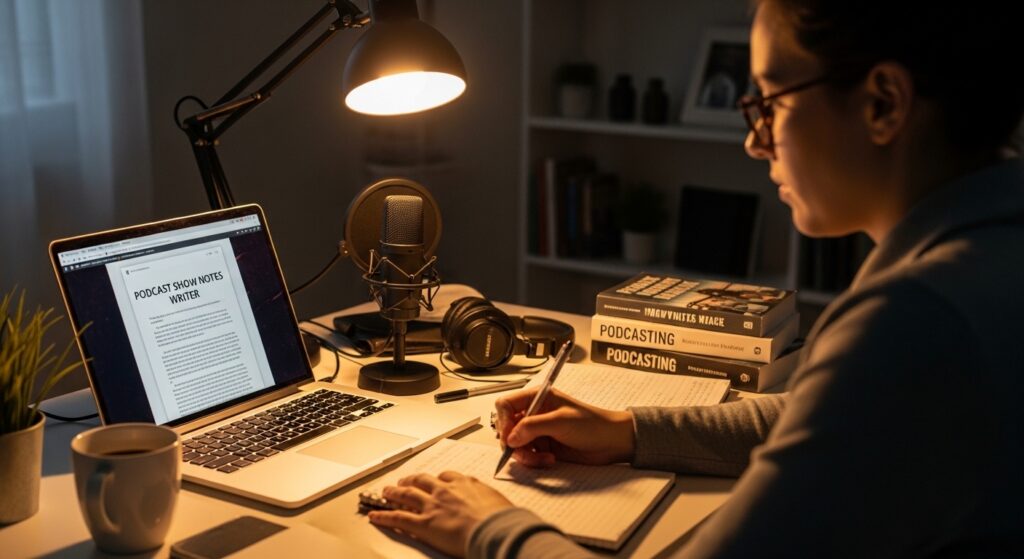
A podcast show notes writer is a freelance content writer who listens to podcast episodes and converts the audio into structured, written content that accompanies the episode online.
Show notes are the written description published below or alongside a podcast episode on platforms like Spotify, Apple Podcasts, or the podcaster’s website. They serve two purposes: helping listeners navigate the episode, and helping search engines (Google, Spotify search) discover it.
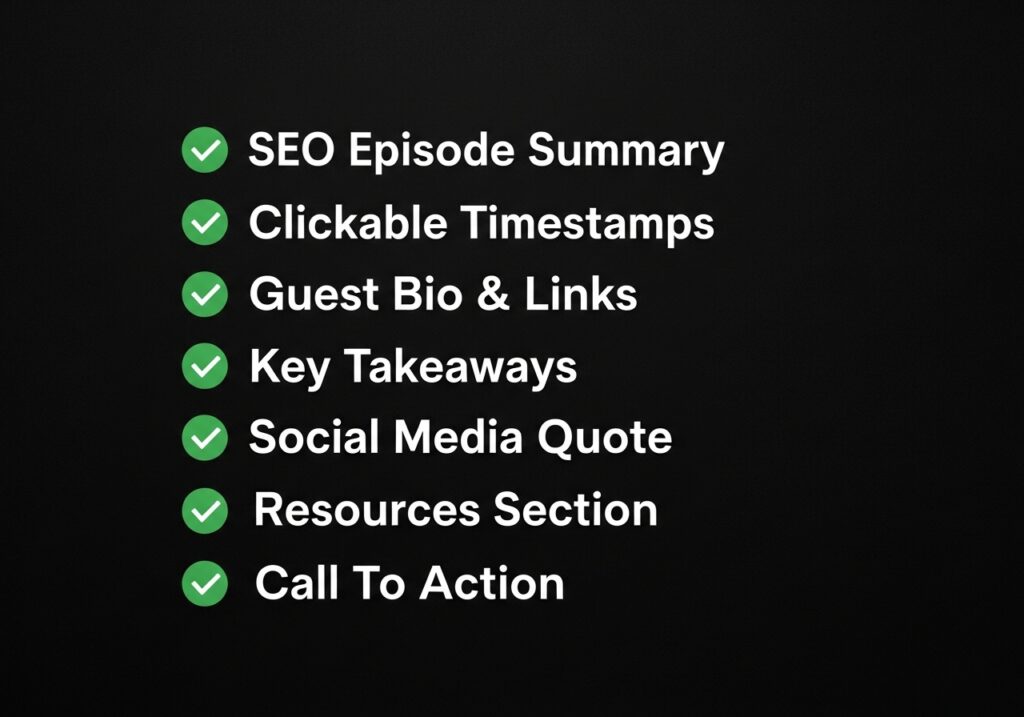
As a show notes writer, your job is to deliver a complete written package from just an audio or video file — no special equipment or studio needed.
📋 Step-by-Step: How to Create Podcast Show Notes
Step 1: Receive the Episode File
The podcaster sends you their audio (MP3, WAV) or video (MP4) file, or a link (Google Drive, Dropbox, YouTube). You also collect basic info: episode title, guest name (if any), and their preferred tone (casual, professional, storytelling).
Step 2: Listen to the Full Episode
Listen attentively with headphones. Use a notepad or Google Doc alongside. Don’t just passively listen — actively note: the main topic, key arguments or stories, guest credentials, any tools/books/links mentioned, and memorable quotes. For a 45-minute episode, this typically takes 60–75 minutes the first few times, speeding up as you build practice.
Step 3: Create Timestamps
As you listen, note the exact minute:second when each new topic starts. Format looks like this:
- 00:00 — Introduction & guest welcome
- 04:32 — How the guest started their business
- 18:15 — The biggest mistake new entrepreneurs make
- 31:40 — Tools and resources the guest recommends
- 44:10 — Final advice and where to find the guest
Timestamps improve listener experience and are a confirmed SEO signal on both Google and Spotify.
Step 4: Write the Guest Bio (if applicable)
Write a tight 60–80 word biography of the guest. Include their title, main achievement, and why they’re on this show. Pull info from their LinkedIn, website, or the host’s intro in the episode. End with links to their website and social profiles.
Step 5: Write the SEO-Optimized Episode Summary
This is the most critical part. Write a 400–600 word summary (or 900–1,500 words for long-form/blog packages) that:
- Opens with a hook — a compelling question or bold statement related to the episode topic
- Naturally includes your primary keyword in the first 1–2 sentences
- Summarizes the episode’s main ideas, insights, and story arc
- Uses H2 headings for each major section (important for Google ranking)
- Reads naturally — never keyword-stuffed
Step 6: Extract Key Takeaways
List 5–7 bullet points of the most actionable, memorable insights from the episode. These should be scannable and valuable even to someone who hasn’t listened yet. Example: “Why posting consistently matters more than posting perfectly” — not just “Guest talked about social media.”
Step 7: Compile the Resources Section
List every tool, book, website, study, or product mentioned in the episode with the correct URL. This section builds credibility and keeps listeners on the show notes page longer — a positive SEO signal.
Step 8: Write a Social Media Pull Quote
Extract one powerful, quotable sentence from the episode. Format it cleanly for Instagram, LinkedIn, or Twitter. Example: “You don’t need 10,000 followers to make $10,000. You need 10 clients.” — [Guest Name]
Step 9: Write the Call-to-Action (CTA)
End the show notes with 1–2 clear CTAs. Examples: subscribe on Apple Podcasts, leave a review, join the email list, follow on Instagram, or visit the sponsor link. Keep it to 1–2 max — too many CTAs reduce clicks on all of them.
Step 10: Format and Deliver
Format everything in a clean Google Doc (or the platform the client prefers). Use clear headings, bold text for key terms, and proper spacing. Deliver before the deadline with a short note explaining what you’ve included and inviting one round of feedback.
✅ Tools You’ll Use
Google Docs for writing, Otter.ai or Descript (free tiers) for auto-transcription to speed up listening, Ubersuggest or Google Keyword Planner for episode keyword research, and Grammarly for proofreading.
📝 3 Real Show Notes Examples
Example 1 — Business / Entrepreneur Podcast
Episode Title: How I Built a $500K Freelance Business Without a Single Social Media Follower
Guest Bio:
James Whitfield is a 7-figure freelance consultant and founder of SoloScale, a community for independent consultants. After leaving his corporate finance role in 2019, he built a fully remote consulting business using referrals and cold email alone. Connect with James at jameswhitfield.com or on LinkedIn @jameswhitfield.
Episode Summary:
What if you could build a half-million-dollar business without posting a single tweet? In this episode, host Maria Chen sits down with freelance consultant James Whitfield to explore how he scaled his solo practice to $500K in annual revenue using nothing but referrals, a razor-sharp niche, and a cold email system most people overlook…
Timestamps:
- 00:00 — Intro: Who is James Whitfield?
- 06:14 — Why he quit his $180K corporate job
- 19:30 — The exact cold email template that lands $10K clients
- 33:45 — How to productize your consulting service
- 47:20 — James’s top advice for freelancers in 2026
Key Takeaways:
- Niching down to one industry (finance) tripled his close rate
- A referral system beats social media for B2B clients every time
- He sends 10 personalized cold emails per week — not 100 generic ones
Resources: SoloScale Community — soloscale.com | Book: The One-Page Business Plan | Tool: Apollo.io for prospecting
Social Pull Quote: “Stop chasing followers. Start chasing conversations. Followers are vanity — conversations are revenue.”
CTA: Enjoyed this episode? Subscribe on Apple Podcasts and leave a 5-star review — it takes 30 seconds and helps us reach more freelancers like you.
Example 2 — Health & Wellness Podcast
Episode Title: Why You’re Always Tired: The Truth About Cortisol, Sleep, and Stress in 2026
Guest Bio:
Dr. Priya Sharma is a functional medicine physician and bestselling author of Rest Reset Recover. She has helped over 3,000 patients reverse chronic fatigue through hormone balancing and lifestyle medicine. Follow her at drpriyasharma.com and on Instagram @drpriyafm.
Episode Summary:
If you wake up exhausted even after 8 hours of sleep, your cortisol levels might be the real problem — not your sleep hygiene. In this episode, Dr. Priya Sharma explains why chronic stress rewires your body’s stress-response system, why standard sleep advice fails most high achievers, and the 3-step protocol she uses with her patients to restore energy from the inside out…
Timestamps:
- 00:00 — Introduction
- 05:22 — What cortisol actually does (and what happens when it’s dysregulated)
- 17:08 — The 4 biggest sleep mistakes high performers make
- 28:50 — Dr. Sharma’s 3-step cortisol reset protocol
- 41:15 — Supplements: what works, what’s overhyped
- 52:00 — Where to find Dr. Sharma and her book
Key Takeaways:
- Cortisol peaks at 8 AM — working out before this window can worsen fatigue for cortisol-dominant people
- Blue light blocking alone won’t fix sleep if your nervous system is dysregulated
- Magnesium glycinate and ashwagandha are the two most evidence-backed supplements for stress
Resources: Book — Rest Reset Recover on Amazon | App — WHOOP for HRV tracking | Study — NIH Cortisol & Sleep Study (link)
Social Pull Quote: “You cannot out-supplement a dysregulated nervous system. Healing starts with the basics — and the basics start with safety.”
CTA: Want more episodes on functional health? Hit subscribe and turn on notifications so you never miss a new release.
Example 3 — True Crime / Storytelling Podcast
Episode Title: The Vanishing of Helen Marsh: A Cold Case Revisited After 30 Years
Episode Summary:
In 1994, 24-year-old Helen Marsh walked out of her apartment in Reno, Nevada — and was never seen again. For three decades, her case sat cold. In this episode, we revisit the evidence, speak to a retired detective who worked the original investigation, and uncover a lead that investigators may have missed…
Timestamps:
- 00:00 — Introduction to the Helen Marsh case
- 08:45 — What witnesses saw on the night of her disappearance
- 22:10 — Interview with retired detective Roy Castillo
- 36:55 — The overlooked phone records
- 49:20 — Where the case stands today
- 54:00 — Listener tip line information
Key Takeaways:
- Phone records from a payphone three blocks from Helen’s apartment were never subpoenaed
- A witness came forward in 2019 but their account was never formally recorded
- The case is still open with the Washoe County Sheriff’s Office
Resources: Washoe County Cold Case Unit — washoesheriff.com/coldcases | Submit a tip — 1-800-XXX-XXXX | Documentary — Forgotten Nevada (YouTube)
Social Pull Quote: “Thirty years. No arrest. No answers. But the people who knew Helen haven’t stopped asking questions — and neither have we.”
CTA: If you have information about Helen Marsh’s disappearance, please contact the Washoe County Sheriff’s Office. And if you want to support the show, share this episode with one person who loves true crime. It genuinely changes everything for us.
💡 Quick Summary
A podcast show notes writer listens → takes notes → adds timestamps → writes an SEO summary → pulls quotes → lists resources → ends with a CTA. The whole process takes 2–4 hours per episode once you’re practiced, and you can charge $25–$120 depending on the package. The real money is in weekly retainers — one podcaster paying you $65/episode × 4 episodes/month = $260/month from a single client, consistently.
Give orders on Fiverr
http://www.fiverr.com/s/o8R7kp4